13/09/2010

No, Dong


So. Johnnie Walker-loving mass murderer Kim Jong-il may be dying. Although it's obviously difficult to tell - he was apparently dying from a stroke in 2008. And from fatal pancreatic cancer in 2009. He's such a tease.

The real question, of course, is whether it's actually going to make any difference if the loveable little Nork-knome kicks it? Media coverage of the Democratic People's Republic seems to suffer more acutely than that of any other country from 'dictatoritis': the implausible belief that the intractability of an international crisis is entirely due to the fact that a single uncompromising psychopath has, despite the political handicap of judgement-obscuring mental illness, somehow managed to seize and maintain control of an entire nation. Just displace Kim and his unhinged family, goes this line of argument, and a new dawn rises over Pyongyang. And while we've all learned to love to hate Bashir, Saddam, Uncle Bob, nowhere has international strategy bought into a dictator's own personality myth as completely as in the case of North Korea.

It seems to be North Korea's 'crime as foreign policy' that encourages the Team America theory of Korean IR. The ballistic missile proliferation. The mass currency forgery. The dodgy Ilyushins laden with weapons on their way to Iran. They all make it easier to think of North Korea as a country captured by a single mad criminal family. In fact, states captured by mafias and crime dynasties (rather than wider elites) seem to tend to be weak states with a lot of ungoverned political space (think central Asia), not highly controlled autocracies like North Korea. Why shouldn't we see the Korean situation instead as something much more common: a state with a corrupt but comprehensive government apparatus, a predictably self-interested elite, locked like others into an intractable but familiar strategic deadlock with a militarily competitive neighbour?

Ballistic missile testing is a case in point. When the Norks test a missile, as in 2009, the Security Council does a Chapter VII nut. Quite right too. It's not often remarked, though, that South Korea also likes ballistic missiles. Enough to have a clandestine procurement programme. It's just that no-one talks about it like that, because it's called a 'civilian space programme', and it does ostensibly useful things like launching 'satellites for climate change research' (so that's all right then). Everyone's very sympathetic when South Korean ballistic missile (sorry, satellite launch vehicle) tests blow up. As in June this year, when South Korea's KSLV-1 rocket exploded moments after take-off. How did the BBC report it?

South Korea's first launch of the two-stage KSLV-1, in August last year, failed to place its satellite payload into the proper orbit.

Four months previously, an attempted space launch by North Korea was deemed to have failed when the US reported that both rocket stages had fallen into the Pacific Ocean.

The North's launch was seen as a cover for a long-range missile test, and prompted UN sanctions.

Pyongyang had voiced irritation at the South's rocket development, but most other powers in the region accepted that its attempt was part of a peaceful civilian programme.


But space rockets are, um, ballistic missiles. Few space programmes are purely civilian or commercial. Even if they genuinely have civilian objectives, they're always developing countries' ability to launch warheads too. Is it any wonder that North Korea gets a bit priapic (and vice-versa, of course)?

Interestingly, as everyone was comiserating earlier this year about South Korea's rocket test failure, a little-reported Florida court case opened an interesting window into South Korea's space programme. It's a grubbily instructive little tale.

According to the court papers: Juwhan Yun, a South-Korean-born naturalised US citizen running a New Jersey-registered company called Blue Hill Corporation, was arrested in April 2009. In May 2010 he finally entered a guilty plea, admitting to brokering a series of illegal arms deals - illegal because Blue Hill Corporation was completely unregistered as an arms broker. Yun had apparently acted for the Korean government to procure everything from Nike missile components, Russian Sukhoi-27 fighter jets, and US-made F-5 and F-16 parts, to an 'RD-180 propulsion system', also from Russia. According to correspondence between Yun and a confidential informant quoted in the investigating agent's affidavit, the RD-180 propulsion system was intended for the KSLV-2, the successor rocket to the KSLV-1 'climate change research satellite' launch rocket that failed this year. Yen apparently told the informant's company that Russia had recently refused to sell the RD-180 rocket engines to South Korea.

While insisting he wanted to do 'legitimate business', Yun appears to have been trying to make arrangements for technology transfer to South Korea in spite of the Russian refusal: leveraging the informant's Russian contacts to obtain RD-180 manuals and technical documentation from Russia, and then trying to find a "retired expert/specialist with much experience at the right job" - apparently approaching a scientist at the University of Central Florida's Aerospace Program - to teach the South Koreans how to nativise the RD-180 rocket engines.


In his post-arrest statements Jun stated that he was working for a "subcontractor for the KSLV programme". The company isn't named in the court papers, but we are coyly told that "a check of public source information via the internet verified that the company identified by Yun is listed as a member of the Korea Defense Industry Association and was previously involved in the Altitude and Orbit Control Subsystem and the Propulsion Subsystem development for the Korean KOMPSAT-1 satellite." It doesn't exactly require a super-sleuth to repeat the googling. Which company? Well I wouldn't want to libel anyone, but, um, think of one of South Korea's largest conglomerates, rhyming with "Whanwha".

If Yun was telling the truth, then it's nice that South Korea's leading industrialists, and its government, were still doing business with him. Because he has some serious form: here he is in 1989,
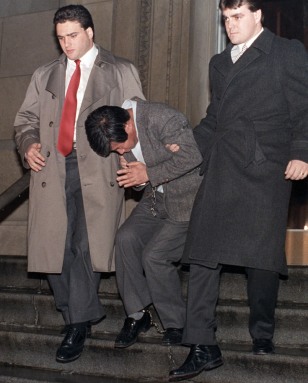


just after being sentenced to two-and-a-half years in prison (and barred permanently from the US arms brokering register) for yet more illegal arms trading. This first time round, Yun had similarly set up shop in the US to buy munitions for South Korea, and ended up acting as an agent for a South Korean trading company while negotiating with a notorious UK arms dealer to buy bombs filled with Sarin nerve gas that Yun told his contacts were for sale to Iran (the deal never went through).

Hmmm. Clandestine ballistic missile procurement? Government-linked arms procurers trying to flog nerve gas to Iran on the side? Which Korea would that be then?

I'm not trying to equate North Korea with South Korea. For instance, the South Korean government doesn't like human rights very much, but it's yet to preside over the starvation of several millions of its citizens.

Nor are South Korea's government, companies or agents unusually dodgy. The point is simply that all governments under military and strategic pressure get involved in this kind of dodgy stuff. The Korean stand-off is a conflict like many others, with aggression, clandestinity and strategic deadlock on both sides. Its resolution, equally, is likely to require political movement on both sides - compromise, not a lucky bout of pancreatic cancer.

11/08/2010

The world turn'd upside down


For various reasons (mainly a new job) I've been thinking a lot about "international development" recently. The development industry's interventions are always socially transformative. Fair enough: whatever you may think about it, social and economic change - "development" - is supposed to be the point. But the direction of social transformation promoted - or permitted - in the Majority World by Western governments and development agencies is often constrained. Constrained either by a liberal self-censorship that prohibits the imperialism of modernisation, and prioritises instead a georgic vision of prosperous, stable, discrete,self-sufficient (and generally rural) communities; or, more straightforwardly, constrained by donors' and developers' conservative tolerance for some social transformations, but not others. With some significant exceptions, Western development donors and agencies are generally in favour of equalising relations between men and women. They're sometimes supportive of formal political democracy (or, more commonly, it's technocratic cousin, 'governance'). And increasingly some agencies promote measures to end unequal power relations experienced by other disempowered groups, such as disabled people.

But one of the last liberal development taboos - even in the Minority World - seems to be to fundamentally challenge power relations between children and adults. And the institution where development practitioners are perhaps at their most self-congratulatory is the key site where children - everywhere - are disempowered and repressed by adults: school. Schools obviously instantiate, inculcate and reproduce unequal power relations of all kinds. And as a result, it's probably fair to say that almost all school eduaction involves widespread and systematic violations of children's human rights. Day in, day out, children at school are denied free expression; are arbitrarily deprived of their liberty and property; have their privacy routinely violated; and are in many cases subjected to cruel, inhuman or degrading punishment.

I'm not suggesting that this is any great hidden scandal. It's a mark of how fundamental the powerlessness of children is in our societies that these deprivations of rights garner almost universal acceptance by adults and children alike. And since wealthy, western societies continue to pretend that they're not happening, you wouldn't expect children's powerlessness to be challenged by our liberal efforts to remake other societies.

Which is why I'm pretty surprised by this: a project to train up Ugandan schoolchildren as education and anti-corruption monitors - to monitor their own teachers. As one of the schoolchildren describes it to ActionAid:

"Every fortnight, we go and see the head teacher and ask him questions. We ask for the receipts for what has been spent and also check the physical amount of things bought. We see whether the head teacher has bought the things or if he has just eaten the money. We would know if the head teacher has eaten the money because we look at the receipts to see if they are forged. We check the displays of releases of money which is required under UPE [Universal Primary Education], and we count the children class by class. If something is wrong, we report this to the head teacher. If the head teacher does not accept what we say, we call the teachers and tell them. We also talk to the [charity involved in running the project]"


Why don't development organisations and donors talk about these kind of projects more? Even if this small inversion of power relations in Ugandan schools didn't detect corruption (it does), it would be worthwhile just for its quiet but astonishingly radical challenge to adult-child power relations. Just picture it - can you imagine British schoolkids being trained to audit the accounts of Academy schools, and to challenge the dodgy spending decisions and bloated salaries of their head teachers and chief executives? Tolstoy, Dewey and Foucault would, I think, have been delighted. And it looks like I'm going to have to eat my words about the U.S. Christian charity jointly responsible for this project - a charity whose child sponsorship scheme in northern Kenya I roundly slagged off elsewhere.

24/07/2010

(1) + (2) + (3) + (4) + ...

I can't think of any more depressing international situation than south/central Somalia. A population trapped between:

(1) unending, rent-seeking clan rivalry

(2) at least two brutal groups of insurgents, one of which regularly amputates teenagers' limbs and stones children to death

(3) a chaotic, Western-backed transitional government in control of just a few blocks of Mogadishu, whose forces have a propensity to sell their weapons to insurgents and recruit child soldiers

(4) an underpowered AU peacekeeping force which admits in its own reports that it indiscriminately shells civilians (arguably because it's too weak and disorganised to do anything else)

How could the international community possibly tinker with this dismal equation to make it any worse? AU chief Jean Ping has a bright idea, which he announced yesterday afternoon:

(5) bolster the AU force in Somalia with a battalion of troops from the armed forces of...Guinea.

The Guinean army? The one which with alarming regularity for over a decade has been opening fire wantonly on its own people? Several units of which attacked peaceful demonstrators just last September, killing 150 people and injuring over a thousand others, and publicly gang-raped over 40 women in the middle of Conakry? A force so factionalised that last December one faction leader shot the president in the head (another military captain who'd seized power in a coup just a year before). A force so remedial that it's currently undergoing near-emergency U.S.-led security sector reform just to prevent another coup or a civil war as Guineans go to the polls in their first ever comparatively free elections. That Guinean army? Still, maybe they'll fit in in Somalia. After all, they've been quite keen on recruiting child soldiers too, at least until their training camps were disbanded after the president's shooting.

There's no denying that the AU force in Somalia (AMISOM) is desperately short of capacity and manpower. That they're effectively used as cannon-fodder by their international backers who don't want to commit troops themselves (but are quite happy to devote tens of millions of dollars and dozens of warships to protect the fraction of their merchant shipping off Somalia's coast which gets attacked by pirates). And, equally, I know that the Guinean army is far from homogenous: that its most factionalised and probably brutalised units, responsible for past and recent atrocities, seem to be concentrated (although not exclusively) in the gaggle of paratrooper and presidential guard units collectively called the beret rouges.

But with SSR just starting, and certainly with no measure yet of its success, it seems insane to think the Guinean army might be ready, even militarily, to play a major role in a peacekeeping operation. My own overwhelming memory of my extremely brief encounter with the Guinean army is a hurried visit to their headquarters at Camp Alpha Yaya in Conakry last November. Dozens of berets rouges and CMIS gendarmes, largely unpaid, sitting around smoking cigarettes in weird, near total silence, most cradling and playing with the long commando knives that they all carried in brown sheathes. The sort of knives that a group of berets rouges were photographed using to casually stab a suspected demonstrator in the suburb of Bomboli on 30 September last year. It's an indictment of AMISOM - and of the lack of serious international commitment to helping Somalia - that these may be the guys tasked vainly with trying to bring security to the streets of Mogadishu.