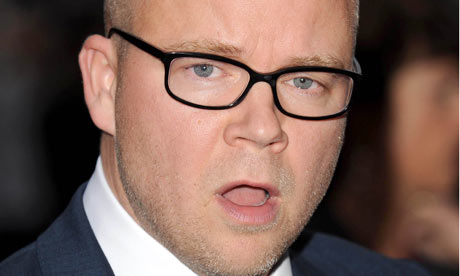
So a new UK school term looms, and I’m wondering how the range-rover’d infants of Hammersmith and Camden are enjoying Michael Gove’s dream of state-funded private schools, in which every child in the land may ultimately aspire to have hazelnut yoghurt for lunch and stockbroking studies after Bible-Time.
And yet when I think with comfortable social-democratic outrage about Toby Young’s
round,
round face, I can’t help also thinking about this phrase, written on a classroom wall in Sheikh Mader primary school in Hargeisa, Somaliland, which I visited last November:

It reads Al-Shitan Al-Ahmar – the Red Devils. Next to it is a Manchester United fantasy football line-up (I especially like the fact that it respectfully includes “Sir Alex Fergusson”, apparently playing in goal).

This graffiti probably says as much about the reach of Man U’s global marketing as it does about the aspirations of the Sheikh Mader students, who dream of fame and fortune under the bright lights of Old Trafford. But those aspirations are nonetheless tangible, powerful, and largely ignored by ‘development practitioners’. What many schoolchildren in Hargeisa want most isn’t ‘development’ in post-war Somaliland: like kids from other dead-end towns and impoverished families from Middlesborough to Kibera, what they want is to get out. Their reasonable if statistically unlikely dream is this: that their golden ticket out of Somaliland is arbitrary excellence in whatever fields are given value and reward for a tiny chosen few in places nicer than the Horn of Africa. Astonishing
ball skills,
marketable beauty, (less commonly) prodigious intellectual prowess.

Sheikh Mader, like thousands of other schools throughout the Majority World, provides basic education, stern discipline (the headmaster’s cane propped in the corner of his office), and can do little else. Its 1300 students, including around 370 Oromo refugees from neighbouring Ethiopia, seem happy; their English fairly good; their classrooms well-maintained if basic. UNHCR and Save the Children Fund have financed the construction of some of its buildings, but its running costs are funded from Somaliland’s tiny $61m government budget. If gender and economic opportunity allows them to stay in school, the most socially mobile of Sheikh Mader’s students will be basically equipped for small business and administrative work in Somaliland and perhaps elsewhere in East Africa. Absent an unforeseen
deus ex machina, they won’t play for Man U, are unlikely to be whisked from Hargeisa to the catwalks of Milan, will never be nuclear physicists or UBS rogue traders.
A good test for political principles is to think about them in extremely resource-scarce environments: places where the consequences of policy are dramatically magnified. What would it mean to have 'free schools' in a place like Hargeisa, educationally selective and freed from the budgetary limitations of Sheikh Mader and schools like it? The likely impacts of capital-intensive free schools on educational opportunity and social mobility in the UK - particularly through restricting the availability of capital funding for state schools in impoverished areas - have been
well discussed. But it’s easy to be fundamentalist about equality of educational opportunity when what is at stake is essentially a place at a classier university. In the Majority World, though, academy schools offer a route - albeit for a tiny, selected few - to the Minority World. If you were a clever teenager in East Africa, wouldn’t you want a scholarship to Harvard rather than a province-wide classroom-building programme? And wouldn’t you naturally resent the Harvard-educated donors, funders, ‘development professionals’, policy advisers, who said otherwise? Equally, the social and economic ripples generated by academies are likely to be much greater in places where educational opportunities are desperately scarce: reinforcing or disrupting elite power far more powerfully than anything Toby Young could hope to achieve.
In Somaliland this calculus of opportunity and aspiration isn’t just a thought experiment. About 15km up the road we visit a second school.
Abaarso Tech, a co-ed boarding school, was established in 2009 by Jonathan Starr, a former hedge fund manager from Cambridge, Massachusetts whose uncle is a prominent member of the Somaliland diaspora.
The school’s been written about quite a lot recently: partly because Starr
has become a high profile critic of international NGOs. In a
Wall Street Journal op-ed last year, Starr argued in
familiar terms that INGOs are the complacent victims of skewed incentive structures that lead inevitably to inefficiency, waste, corruption, "diseconomies of scale": accountable to donors rather than beneficiaries, and lacking the continual performance assessment of profit-seeking businesses.
Starr’s school is intended as a demonstration project of how to 'do development' differently. As a recent CS Monitor feature headline proclaimed: "
Abaarso Tech, run like a business, brings top-notch education to Somalia". Although he wasn’t there when we visited, Starr spends much of his time living and working at his school alongside fourteen American and Canadian staff – recently-graduated Ivy Leaguers, albeit most with no formal teaching qualifications.
When we visit, Abaarso Tech is at about half capacity, with 99 students across two school years. The fiercely dedicated teacher who shows us round explains that they aim initially to stay small. Creaming off the top 50 each year from Somalia’s national Grade 8 examination, the school will have 200-240 students across grades 9 to 12. Students selected for entrance, according to our guide, are accepted irrespective of their ability to pay.
Abaarso Tech’s clearly flourishing students enjoy educational experiences unknown across the rest of Somaliland. We arrive in the late afternoon at the school’s high-walled hilltop compound, its gates flanked by private guards carrying the distinctive pastel-blue Kalashnikovs found throughout Somalia since Siad Barre’s regime. (Abaarso Tech’s teaching staff probably constitutes the highest concentration of Americans in Somalia north of Mogadishu, so this security is unsurprising). Inside, queues of boys and girls (together) are chattering as they line up for science club. Others sit at a bank of a dozen laptops, along with a donated library of second-hand textbooks and novels which the school’s
website suggests may be "the largest [library] in Somaliland". The hallways of the school’s frugal main building are plastered with felt-tip posters quoting John F. Kennedy and Barack Obama, ready for the student elections that night.

It’s certainly not luxurious, but it’s a far cry from the Oromo refugees and dusty city-centre playground at Sheikh Mader. What isn’t clear, though, is whether Abaarso Tech’s facilities and ambitious curriculum are really generated by a distinctive business model. Starr insists that non-profits should submit themselves to the
“ultimate customer-feedback metric of revenue”, and that his organisation has been designed to be run
“like a business with the Somali people as both shareholders and customers” . But his school has so far financed itself more or less like any other donation-based charity. Some students pay the full $900 annual fees (around three times Somalilanders’ average annual income, according to
best estimates), and a small number of ‘international’ students from the Somali diaspora pay around $5000 a year. And Abaarso Tech has a range of other revenue-raising programmes: weekly adult English classes, for which around 60 people from Hargeisa and elsewhere pay around $300 a term; and a nascent ‘MBA programme’ for Somaliland’s flourishing business community. Ambitious parents can also sign their primary-school-age children up for tutoring by current students. Nonetheless, we’re told, around 85% of the school’s start-up capital and first-year running costs have come from private grants (
in money-where-your-mouth-is style, this has reportedly included perhaps half from Starr’s own wealth), plus in-kind donations of books, cheap computers, and the land on which the school is built. Although Starr may publicly critique government and donor funding, a further 10%, we’re told, comes from a UK FCO grant. According to one teacher the school also accepted an indefinite annual grant of $50,000
promised by the Somaliland government from its own budget - reportedly reduced after the 2010 elections to $8000. (It’s difficult to check these figures, since Starr’s organisation, despite its disdain for INGO unaccountability, has as yet published no accounts or annual report, although they did respond helpfully to emailed questions for this blog).
Abaarso's capacity to self-fund may improve. Starr insists in an email that after this initial start-up phase, “we expect to reach operating breakeven in the next year or 2”, based in part on projecting that around 20% of the student body may eventually be drawn from the wealthy Somali diaspora. But at least in its start-up phase, Abaarso Tech has had a conventional ‘non-profit’ procurement structure, drawing on donations, volunteers and gifts-in-kind. Its library books come from the US charity
Books for Africa at under $1 a book. The land for the school itself was donated by Abaarso elders. Like many other educational charities, the school relies primarily on young, Western, part-volunteer staff, earning $3000 a year, most recruited as new graduates from North American universities, including through volunteering websites like idealist.org. Neither the staff nor the school as a whole operate as a market-rate business: as Starr says in an email, “I make a sacrifice and the staff makes one too. We make that donation because we get paid in seeing something beautiful occur.”
There’s absolutely nothing wrong with this. It’s simply that beneath Starr’s self-proclaimed iconoclasm, the start-up phase of his business model looks just like a conventional charity. Abaarso Tech’s financial accountability and sustainability currently don’t seem clearly better - and probably not much worse - than most INGOs.
But the ‘NGO vs. business’ debate is neither the germane nor the interesting question here. What seems
genuinely distinctive about Abaarso Tech is not its business model, but its educational philosophy. Its stated goal is
straightforward: to skim elite educational achievers from the country’s school system and to prepare them to leave Somaliland for Ivy League universities abroad. If Absaarso Tech seems like an incongruous bubble compared to dusty downtown Hargeisa, it’s supposed to. All classes and activities are conducted in English. All fourteen teachers when we visited were young Western ‘internationals’; we met a young Somaliland woman introduced to us as the sole Somali translator for the entire school – a school whose students’ first language is almost exclusively Somali. Indeed, within the school’s buildings the (residential) pupils are forbidden on pain of punishment (non-corporal, unlike the uncompromising regime at Sheikh Mader) from speaking anything but English.

Abaarso Tech’s assumption is that after attending elite universities abroad, Abaarso’s students will return home, Western-educated and internationally-oriented, to become Somaliland’s future business and political leaders. Like a good hedge fund manager, Starr is spotting a small number of good educational investments early on, and betting on their ability to deliver later in their lives. This is the polar opposite of most educational charities’ aim to provide education to the broadest possible swathe of society: not only to spread economic opportunity but to fulfil a
human right to basic education.
Rights aside, the utilitarian question remains: is a wealthy, foreign-educated elite combined with an immensely impoverished, poorly educated population really the ticket to Somaliland’s economic development or political prosperity?
To some degree there is already an answer to this question. Somalia in general - Somaliland included -
already has a well-educated, wealthy and internationalised diaspora, spread across Europe and North America, now entering its second generation since the start of civil war in 1991, and frequently drawn upon to parachute senior leadership into the region's shattered governments. The new TFG prime minister, Abdiweli Mohammed Ali, returned to Somalia in 2010 after 24 years studying and teaching economics at US universities. Many of his new cabinet appointees are businessmen and academics from Canada, the UK and the United States. Even the new Mayor of Mogadishu, Mohamed Nur, spent the previous 19 years working for London’s Islington Council. In the strategic port city of Berbera, the capital of the Sahil province 90 miles east of Hargeisa, we meet a twenty-something Somalilander who welcomes us into the office of the provincial governor with a broad Wisconsin drawl. Born in the American mid-west, he arrived weeks earlier as the governor’s senior adviser.
In other words, the migratory fall-out of Somalia’s two decades of civil war has already to some extent built the elite international cadre that Abaarso Tech aims to establish. But even in the few instances when they
have been persuaded back ‘home’, it’s not at all clear whether these well-off and well-educated Somalis have indeed been able to deliver peace or economic development in the face of the country’s chronic political and social fractures. By contrast, the miracle that Somaliland’s government wrought out of the chaos of the 1990s – peace in its territory, despite northern Somalia having been the crucible of the early civil war; and sufficient political stability to have seen, in 2010, the only peaceful, democratic change of government in East Africa in over a decade – appears to have been
homegrown: achieved through an extraordinary, painstaking sequence of domestic clan-based negotiations during the 1990s.
And indeed some argue that the roots of civil war in northern Somalia lay precisely in the inequalities of educational and professional opportunity that already existed in Somaliland under British rule: an Anglophone elite - mainly from the Isaak clan and educated in British schools - dominated administrative positions in British-occupied Somaliland; were, in retaliation, then excluded by Siad Barre’s discriminatory policies in independent Somalia; and as the progenitors of the SNM rebellion in the early 1980s, have returned to dominance in independent Somaliland’s present-day government, military and economy.
But let’s say we set aside the politics too. To take it back to market fundamentals: what is the opportunity cost of the $1.5 million so far spent on Abaarso Tech’s set-up and initial running costs? $1.5 million is over 50% of the Somaliland government’s entire 2010 education budget (14,633,732,140 shillings). Would this money have been better spent fed through the government budget, spread across Somaliland’s creaking schools and perhaps
5 million school-age children? I don’t have any straightforward answers to that question. (And of course, it’s not a straightforward comparison, since it doesn’t account for foreign donor funding for education in Somaliland that never passes through the Somaliland government’s books). But it highlights the kind of stark choices involved in academy education. Do we funnel scarce resources into creating an educational elite, however meritocratic? And does that elite grow a nation’s wealth and power, or foster tensions in fractured societies?
These are questions that matter as much in Western Europe as in the Horn of Africa. Ask a bright schoolchild at Sheikh Mader primary school, though, and I suspect you’d get an answer that didn’t deal either with politics or utility. They’d say that they deserved the opportunity to escape Somaliland altogether. And I suspect they’d welcome Abaarso Tech’s laptops and science club, or any other route that allowed them to do so.
 Opportunity knocks? The view from Abaarso Tech's school gates