

Glamour Magazine. Blows. My. Tiny. Mind.
I was flicking through last month's Glamour on the loo a couple of days ago (too much information?) when I came across this beauty. That's right folks, it's a handy flowchart telling you when you should split up from your partner if he's [sic] been unfaithful.
As you can see, there are only two basic varieties of 'emotional infidelity'. Either you work together, or you don't. Similarly, physical infidelity comes in just two flavours: drunk / not drunk. (Actually, that bit does pretty much cover the many-coloured palette of my sexual experiences, but we'll skip on). If it happened more than once while drunk, he's probably an alcholic.
And so on.
What I love most about this diagram is the kind of business-skirt-Bridget-Jones-too-many-chardonnays life pattern it assumes everyone lives. As in any flowchart, there are at least two different kinds of reduction going on here.
First there's the category reduction in the boxes: reducing a universe of emotional experience - a thousand years of cultural and literary reflection on the subtle, sinuous, tragic and comic ways in which two people's relationship flexes - into ten fifty-word scenarios.
Then there's the causal reduction in the lines between the boxes. In this case, the progress of the 21st-century Western middle-class relationship is explained by alcohol, work and communications technology. These are the three fundamental forces that govern emotional motion in this universe. Meaningless flirtation outside the workplace? Emotional infidelity not mediated by email or text message? Loss of control caused by anything other than substance abuse? None of these things can exist. They're against the laws of physics.
Or maybe I'm reading a tad too much into what is, essentially, Just a Bit of Fun.
But I'm not so sure. The more I think about it, the more I wonder whether maybe this flowchart might actually be true. At least for Glamour magazine's core demographic. Or rather, maybe it and its friends have made themselves true. Maybe a decade of Cosmo relationship flowcharts, shackled to the growth of post-industrial capitalism's casualised* white-collar service sectors, has actually made Western urban life like this? Maybe this flowchart actually diagnoses the entirety of our under/overemployed, lower-middle-class, low-seratonin metroliving in ten pastel-coloured boxes? A schematic for emotional-death-by-temping. The more I think about it, the more I think maybe it's a work of genius. AAAAAAAAAAAAAAAAAAARRRRRRGGGGGGHHHHHHHHH.
The bigger point is that there's total coherence in Glamour magazine's choice of schematic. The flowchart and its cousins are the emblematic technology of 'management science': the 20th century's ur-science, whose rise both created the business models that keep us permanently overworked yet casualised, rootless and moving from short-term job to short-term job; and which thereby confines our emotional lives to workplace flirtation, inappropriate emails and after-work drinking. It seems only appropriate, then, that those impoverished emotional lives should also be described and directed by flowcharts.
The important thing, of course, is the self-fulfilling cognitive impact of this kind of diagramming. There's nothing wrong with using a diagram to summarise important temporal and causal relationships (although there are diagrams better than flowcharts to do this - they're designed for computer programmes, not the kinds of complex systems better described, in fact, by the allusiveness of formal language). But once you start to use any schematic to explain things, there's a temptation to think that this is how the situation you are trying to explain actually is. That the model is the thing it models. Etc. And then to act that way.
Beyond the ordinary propensity of any sufficiently influential model to make itself true, flowchart capitalism works to make flowchart psychology true. Egged on by the narrow models of management consultants and the OECD, companies and governments seek to reduce labour costs and labour market rigidity. The less job security we have, the more time we need to spend organising our employment arrangements (and organising our lives around our employment arrangements). The more we're forced to do more labour for less money and with fewer people, the more we have to spend our entire lives at work. So, ironically, the less job security and fewer labour rights we have, the more significant the workplace becomes in our social lives. And the more our labour conditions increase the combination of repetitive boredom and stress that we need to assuage with flirty emails and heavy drinking.
In short: deregulation makes us office sluts. As Karl Marx would say.
I'm actually being pretty serious here. The genealogy that gets us from flowcharts to Bridget Jones remains one of the most under-explored narratives of 20th-century history. Philip Mirowski's provocative re-writing of the history of economics (and the history of science) provides, as far as I know, the most detailed account so far. The Ladybird version goes something like this:
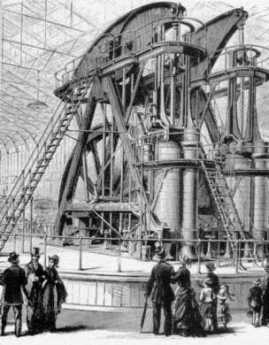 1. In the 19th century, thermodynamics begat neoclassical economics. Physicists - and, more significantly, theory-minded engineers, especially ones that were working on steam engines - are the forgotten theorists that produce the doctrines of the new economics, based upon thermodynamic models. Utility is patterned on potential energy, down to its formal mathematics. In other words, the scientific ideas and machines that fuelled industrial capitalism also provided the economic theory that - after the fact - describes and justifies industrial capitalism.
 2. In the 1940s and 1950s a new strand of thinking about automata and robots provided the forgotten intellectual origins of post-war mathematical economics: developments in neoclassical price theory, rational expectations theory, theories of institutions, and computational economics. Physical scientists and engineers, working mainly in the United States on operations research, game theory, computers, missile servomechanisms and strategic bombing models, are again the central thinkers. And consequently the model human at the heart of neoclassical microeconomics is not Adam Smith's homo economicus. It's the cyborg.
In Mirowski's account the axial figure of this second phase is mathematician, operations researcher, game theorist and CIA consultant John von Neumann. The eccentric genius of whom his Princeton colleagues said that "he had made a thorough, detailed study of human beings and could imitate them perfectly".
Then there's the third act to this account, which I think has still to be adequately written. It starts from the fact that the other thing these precocious operations researchers and engineers are doing in the first half of the 20th century, as well as revolutionising neoclassical economics, is creating management science. Moving beyond the factory time-and-motion studies of Ford and Taylor, they're trying to make missiles and machines and factories and businesses work more efficiently, in part by making people more like machines.
Somehow management 'science' - not economics - becomes the master discipline of the late 20th century. The management consultants who make up the discipline's priesthood start fanning out from McKinsey and PA Consulting and Booz Allen, determining not just how manufacturing processes, but soon how whole corporations, cities, armies, government departments and societies, should be organised. By the late 20th century the re-imagining of workers, processes and institutions as industrial machines - and their re-engineering for 'efficiency' - seems to have won out over other candidate 'ur-sciences' (economics, social anthropology). And of course the basic spanners and wrenches of the management practitioners mirror, but in totally bastardised form, the prescriptions of the economics that was also substantially generated by management science's progenitors: identify ineffeciencies or 'synergies'; fire those workers unfortunate enough to be employed in an 'inefficient' position; and ensure that everyone left is working as long and as fast and as cheaply as possible.
And of course, with this parenthood, it was only natural that management science should so enthusiastically embrace the flowchart: the analytical tool first probably formalised (for designing computer programmes, not factory processes or business models) by John von Neumann.
See!
I've been meaning to write a lot more about the global intellectual triumph of 'management' and its bizarre manifestations (to take one small instance, how the management consulting firm Adam Smith International, in conjunction with DFID, are currently restructuring the Sudan People's Liberation Army). And the homogenous picture of neoclassical economics I've badly sketched here is, of course, a total caricature. But this is already way too long. So for now, I'll leave it with this.
NATO have a new strategy for Afghanistan, right? The proposed solution to what is arguably Europe's and the United States' most important foreign policy problem. In December, NBC's Richard Engels got hold of a copy of some declassified bits from the office of the Joint Chiefs of Staff. The master document is this - produced, it appears, by noted counter-insurgency specialists, er, PA Consulting.
The Mother of all Flowcharts.

This is how we're bringing peace to Afghanistan. And romance to our tired treadmill lives. And we wonder why we're so fucked.

* In case Per or any other actual economists are reading this: I think I mean increased external numerical flexibility in the labour market. I'd be grateful for correction if there's a more appropriate metric, though.

